
优秀学术论文成果展示6:A Hierarchical Full-Resolution Fusion Network and Topology-Aware Connectivity Booster for Retinal Vessel Segmentation
发表期刊:IEEE Transactions on instrumentation and measurement
分区:SCI1区
日期:2024年6月8日
作者:高乐
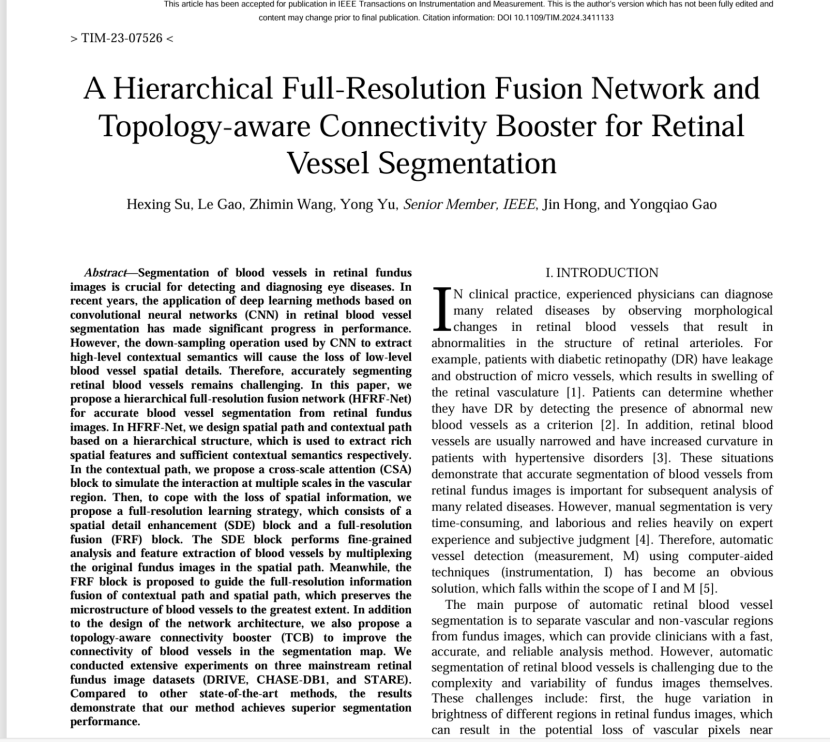
中文摘要:视网膜血管分割对眼病检测与诊断至关重要。近年来,基于卷积神经网络(CNN)的深度学习方法在视网膜血管分割领域的应用取得了显著性能提升。然而,CNN通过下采样操作提取高层次语义特征时,会导致低层次血管空间细节的丢失。因此,准确分割视网膜血管仍面临挑战。本文提出一种分层全分辨率融合网络(HFRF-Net),用于实现视网膜血管的精准分割。该网络采用分层结构设计空间路径和语义路径,分别用于提取丰富的空间特征和充分的上下文语义。在语义路径中,我们创新性地提出跨尺度注意力(CSA)模块,模拟血管区域多尺度交互。针对空间信息缺失问题,我们开发了包含空间细节增强(SDE)模块和全分辨率融合(FRF)模块的全分辨率学习策略。SDE模块通过在空间路径中复用原始眼底图像,实现血管的精细分析与特征提取。与此同时,我们提出FRF模块来引导上下文路径与空间路径的全分辨率信息融合,最大限度地保留血管的微观结构特征。除了网络架构设计外,我们还开发了拓扑感知连接增强器(TCB),以提升分割图中血管的连通性。我们在DRIVE、CHASE-DB1和STARE三大主流视网膜眼底图像数据集上进行了大量实验。与现有前沿方法相比,实验结果表明我们的方法在分割性能上具有显著优势。
英文摘要:Segmentation of blood vessels in retinal fundus images is crucial for detecting and diagnosing eye diseases. In recent years, the application of deep learning methods based on convolutional neural networks (CNN) in retinal blood vessel segmentation has made significant progress in performance. However, the down-sampling operation used by CNN to extract high-level contextual semantics will cause the loss of low-level blood vessel spatial details. Therefore, accurately segmenting retinal blood vessels remains challenging. In this paper, we propose a hierarchical full-resolution fusion network (HFRF-Net) for accurate blood vessel segmentation from retinal fundus images. In HFRF-Net, we design spatial path and contextual path based on a hierarchical structure, which is used to extract rich spatial features and sufficient contextual semantics respectively. In the contextual path, we propose a cross-scale attention (CSA) block to simulate the interaction at multiple scales in the vascular region. Then, to cope with the loss of spatial information, we propose a full-resolution learning strategy, which consists of a spatial detail enhancement (SDE) block and a full-resolution fusion (FRF) block. The SDE block performs fine-grained analysis and feature extraction of blood vessels by multiplexing the original fundus images in the spatial path. Meanwhile, the FRF block is proposed to guide the full-resolution information fusion of contextual path and spatial path, which preserves the microstructure of blood vessels to the greatest extent. In addition to the design of the network architecture, we also propose a topology-aware connectivity booster (TCB) to improve the connectivity of blood vessels in the segmentation map. We conducted extensive experiments on three mainstream retinal fundus image datasets (DRIVE, CHASE-DB1, and STARE). Compared to other state-of-the-art methods, the results demonstrate that our method achieves superior segmentation performance.
用户登录